
Poppy
June 2023
This quilt has been in process since late 2021, when I began hand embroidering the flower design on the red poppy print blocks. In early 2022, I completed piecing it (on sewing machine). Since I wanted to hand quilt it, by the time summer came around, I had little interest in having a quilt draped on me while hand quilting. By October, the weather had cooled enough, but it still took a few months to get it across the finish line. I finally finished it earlier this year, but hadn’t taken time to write a post about it, as I was more anxious to see it on the bed for which I had intended it!
During the hand quilting stage, I made a makeshift quilting frame by attaching a curtain rod to the wall (immediately below the window in picture). I used my ironing board to other side to create the side-to-side tension. Being the first time doing hand quilting, I had no frame of reference (nor quilting frame – haha) for how to go about hand quilting, but I thought my makeshift set-up worked pretty well and I was happy with it.
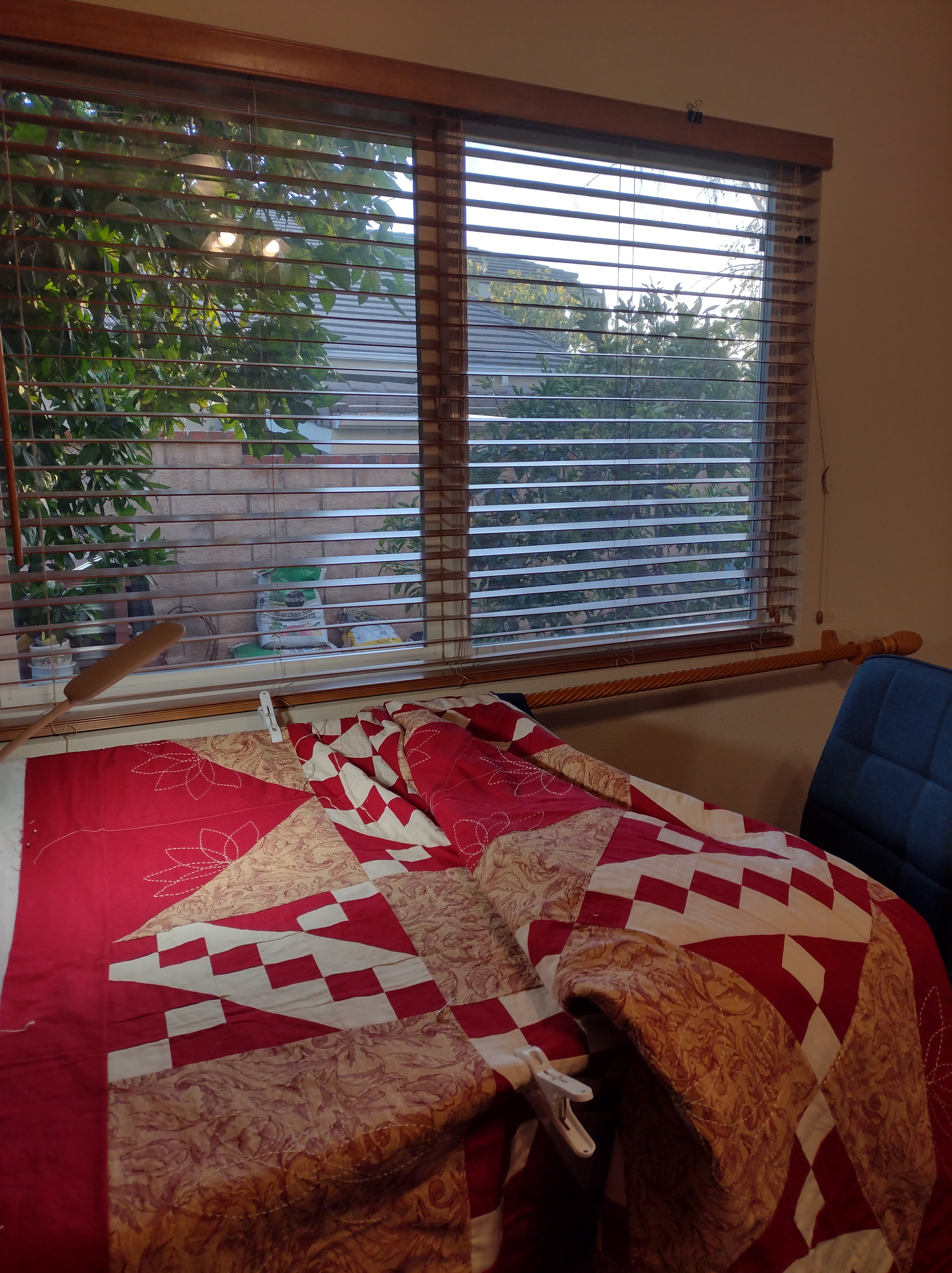
The red poppy print fabric was some that was handed down to me from my Granny. I’ve had it in my stash for many years, knowing that I wanted to make something special with it. I’ve also wanted to make a redwork quilt for several years, and this seemed to be the perfect place to use the fabric. I purchased Kona cotton in wine and ivory colors to compliment the print. The quilt pattern was part of a 2014 Quilt-a-Day calendar, and is called Underground Railroad Quilt by Debby Kratovil, © 2013. While the calendar had the pattern notated as such, I personally wonder if it had been a typo, as it doesn’t look like a traditional Underground Railroad Quilt, but closer to a modified version of a Jacob’s Ladder quilt.
 Love Hugs
I do love a red and white quilt, although strangely I’ve never made one. This one’s a beauty! I think your hand quilting set up sounds perfectly reasonable; I don’t use a frame myself. Instead I roll the sandwiched quilt up except for the bottom 12″ and start there, using the weight of the rolled quilt to provide tension, and a heavy steel ruler at the bottom edge once it’s done. As I go, I roll up the bottom edge, and this also provides tension. It’s unconventional, but it works for me and has for several large hand-quilting projects. You do you!